

If you wanted credibility in QA automation, you learned Selenium, Java, Python, Cypress, Playwright, Appium, or some combination of all of them. Entire automation strategies revolved around frameworks, locators, libraries, dependencies, and custom code architecture. Teams proudly measured maturity by how sophisticated their frameworks looked.
And for a long time, that model made sense. Applications were becoming more dynamic. Agile delivery cycles were accelerating. Manual testing simply could not scale. Scripting gave teams control, flexibility, and engineering precision.
But over the last few years, we’ve watched something fundamental change.
The biggest problem in enterprise test automation is no longer whether automation is possible. The biggest problem is whether automation is economically sustainable.
That distinction matters.
Because most organizations today are not struggling to write automated tests. They are struggling to maintain them, scale them, and operationalize them across increasingly lean teams and increasingly aggressive release cycles.
This is precisely where no-code test automation platforms have started reshaping the economics of software quality.
Not because scripting disappeared. It hasn’t. But now the industry is finally realizing that excessive dependence on scripting creates structural bottlenecks that most modern QA organizations can no longer afford.
The Original Promise of Script-Based Automation
To understand why no-code platforms are gaining momentum, it’s important to understand why scripting became dominant in the first place. Traditional automation frameworks offered enormous flexibility. Teams could customize execution logic, integrate deeply with CI/CD pipelines, create reusable libraries, and automate virtually anything.
For technically mature engineering teams, scripting was empowering. But that power came with hidden costs.
Over time, enterprise automation suites became increasingly fragile. Every UI change broke locators. Every framework upgrade introduced compatibility risks. Every new tester required weeks or months of onboarding before contributing meaningfully. And eventually, many organizations found themselves trapped in a paradox: They had automated extensively, yet releases were still slowing down.
Why?
The maintenance burden quietly replaced the original efficiency gains.
This problem is not theoretical. Research from industrial studies on automated GUI testing found that verification and validation activities account for roughly 20–50% of total software development costs, with maintenance emerging as one of the largest long-term automation challenges.
That number becomes even more significant inside Agile environments where release cycles occur weekly—or even daily.
Related Reading:
The Maintenance Crisis Nobody Talks About Enough
One of the most misleading narratives in automation is the assumption that automation reduces effort permanently.
In reality, automation shifts effort.
Initially, scripting reduces repetitive manual execution. But as applications evolve, effort migrates toward framework maintenance, locator updates, flaky test stabilization, and debugging.
Eventually, the organization realized something alarming. They were spending more time maintaining the automation suite than expanding meaningful coverage.
Ironically, the automation framework had become the bottleneck it was originally meant to eliminate. This is one of the core reasons no-code automation platforms emerged, not as replacements for engineering rigor, but as attempts to reduce the operational dependency on scripting-heavy maintenance models.
What No-Code Platforms Actually Change
The popular misconception is that no-code automation platforms simply “remove coding.” That description is far too simplistic. What they really do is abstract complexity away from the user.
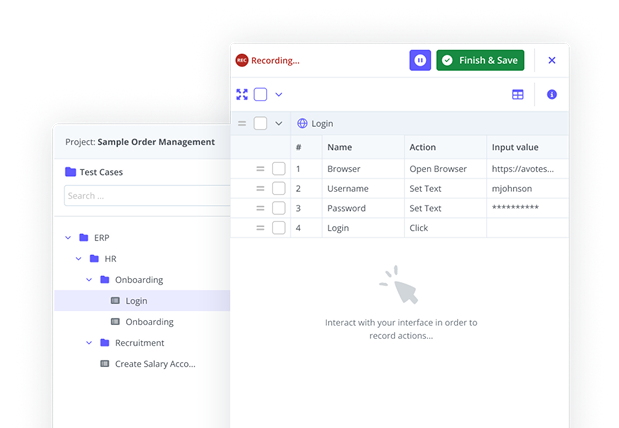
Instead of requiring testers to write explicit code for interactions, assertions, synchronization, and execution logic, no-code platforms encapsulate these behaviors into reusable visual actions, workflows, and prebuilt components.
The shift is architectural as much as technical. The automation logic still exists beneath the surface. But the tester interacts with a higher-level abstraction layer rather than raw code.
This changes several things simultaneously.
First, it reduces the dependency on highly specialized programming skills for day-to-day automation tasks.
Second, it dramatically shortens onboarding time for non-developer contributors.
Third, it centralizes maintenance logic, meaning updates can propagate across multiple tests without manual script rewrites.
And finally, it enables testing to become more collaborative across QA engineers, business analysts, product owners, and functional testers.
Research on low-code and no-code automation highlights this democratization effect clearly, emphasizing how these platforms make automation accessible to professionals without extensive coding expertise.
Related Reading: No Code Testing For Enterprises | Everything You Need to Know
The Democratization of Test Automation
This democratization aspect is arguably the most transformative change.
Historically, automation ownership was concentrated among a small group of technical specialists. Manual testers depended on automation engineers. Business users were largely excluded. Domain experts participated indirectly through documentation and validation.
No-code platforms challenge that operating model.
By using visual workflows, drag-and-drop interfaces, reusable components, and natural-language abstractions, they allow non-programmers to participate meaningfully in test case creation.
That shift fundamentally changes scaling dynamics inside QA organizations.
Instead of automation becoming constrained by developer bandwidth, it becomes distributed across a broader contributor base.
According to industry observations, adoption of low-code/no-code platforms has accelerated significantly as enterprises seek to reduce dependence on scarce engineering resources and improve cross-functional collaboration.
This is particularly valuable in enterprise environments where domain knowledge matters as much as technical expertise.
A business analyst validating an SAP procurement workflow may understand the business process far better than an automation engineer writing Selenium scripts.
No-code platforms reduce the translation gap between domain understanding and engineering implementation.
Why Lean QA Teams Are Driving Adoption
The rise of no-code automation is closely tied to another trend: leaner QA organizations.
Modern engineering leadership increasingly expects:
- Faster release cycles
- Broader test coverage
- Reduced operational costs
- Smaller testing teams
Those expectations are extremely difficult to satisfy with traditional scripting-heavy models.
Why?
Scripting scales linearly with engineering dependency.
Every new automation initiative requires:
- Coding expertise
- Framework governance
- Maintenance ownership
- Technical debugging
- Continuous skill development
No-code platforms alter this equation by reducing the amount of specialized scripting required for common automation activities.
That reduction creates operational leverage. A smaller team can automate more workflows because effort shifts away from framework engineering and toward scenario validation. This efficiency gain is one reason organizations increasingly view no-code platforms as economic solutions rather than purely technical ones.
Related Reading: Top Test Automation Trends 2026: A Strategic Perspective
The Relationship Between AI and No-Code Automation
The emergence of AI has accelerated this transition even further.
Modern no-code platforms increasingly integrate:
- AI-assisted test creation
- Self-healing mechanisms
- Natural-language test generation
- Intelligent locator strategies
- Predictive maintenance
These capabilities reduce scripting dependency even more because they automate tasks traditionally requiring human intervention.
AI-assisted no-code automation demonstrates how large language models are being used to help business users generate automations using natural language rather than traditional programming constructs.
This represents a profound shift.
Historically, automation required humans to adapt to programming paradigms. Increasingly, automation systems are adapting themselves to human intent. That changes who can participate in automation creation—and how quickly.
The Real Economic Driver: Maintenance Reduction
If I had to summarize the core business reason no-code platforms are gaining traction, it would be this:
They reduce maintenance friction. And maintenance is where most automation programs quietly fail.
Industrial research repeatedly identifies maintenance as one of the primary cost drivers in automation programs.
No-code platforms attempt to mitigate this through:
- Centralized object repositories
- Visual element identification
- Reusable components
- AI-driven locator updates
- Modular workflow design
The objective is not to eliminate maintenance entirely. That’s unrealistic. The objective is to reduce the operational burden enough that automation remains economically sustainable at scale.
The Criticism of No-Code Platforms Is Also Valid
Now, this is where the conversation becomes more nuanced.
No-code automation is often marketed as a complete replacement for scripting. In practice, that claim is exaggerated.
There are legitimate limitations.
Complex workflows, edge-case logic, advanced integrations, and highly customized scenarios often still require coding expertise.
Community discussions among experienced QA engineers consistently point this out. Several practitioners note that while no-code tools simplify basic automation, scalability and maintainability can still become problematic without strong automation architecture principles.
And honestly, I agree with that criticism.
Bad automation practices do not disappear simply because the interface becomes visual.
A poorly designed no-code suite can become just as chaotic as poorly written code.
Automation still requires:
- Strategy
- Modularity
- Governance
- Prioritization
- Engineering discipline
The platform changes the interface layer. It does not eliminate the need for quality engineering fundamentals.
Related Reading: Why Your No-Code Test Automation Tool Isn’t Really Intelligent (Yet)
Why Hybrid Models Are Becoming the Dominant Pattern
What I increasingly see in mature organizations is not a complete shift away from scripting, but the emergence of hybrid automation models.
In these environments:
- No-code handles common workflows
- Low-code supports customization
- Engineers extend capabilities when necessary
- Business users contribute domain-driven coverage
- AI assists maintenance and optimization
This balance is important because enterprises rarely operate in purely simple environments.
The future of automation is likely not “code versus no-code.” It is orchestration between abstraction layers.
Related Reading: How should IT directors compare enterprise test automation platforms?
A Shift in How We Define Automation Maturity
Perhaps the most interesting change is philosophical.
For years, automation maturity was associated with technical sophistication:
- Advanced frameworks
- Complex architectures
- Custom libraries
- Engineering-heavy implementations
Today, mature organizations increasingly define success differently.
The questions have changed.
Instead of asking:
“How advanced is our framework?”
They ask:
“How sustainable is our automation model?”
Instead of:
“How much code did we write?”
They ask:
“How efficiently can we validate business risk?”
That shift is subtle, but extremely important.
Because the ultimate goal of automation was never scripting. The goal was scalable quality. And in many organizations, scripting gradually became an obstacle rather than a solution.
Related Reading: No Code Testing: Practical Tips for Non-Technical Testers
Conclusion
No-code test automation platforms are not replacing engineering expertise. They are redistributing it.
They reduce reliance on scripting by abstracting repetitive technical complexity, enabling broader participation, lowering maintenance overhead, and accelerating automation scalability across lean teams.
But the real transformation is not technological. It is operational.
Testing is moving from a model dependent on specialized automation engineers toward a model where automation becomes embedded across the broader delivery organization.
IDC predicts in the next 2 years, individuals outside traditional IT departments will account for over 80% of AI-assisted no-code platform users globally. That forecast reflects a broader structural change: automation is moving from a specialized engineering activity toward an organization-wide capability.
That shift changes the economics of QA. It changes who contributes. It changes how fast teams can scale. And perhaps most importantly, it changes the long-standing assumption that meaningful test automation must always begin with writing code. Because increasingly, it doesn’t.
If you are stranded and are looking to take the first step into no-code test automation, this can be an insightful read