Best practices, ERP Testing
Business Process Assurance: Why Passing Tests Isn't the Same as a Working Business
Introduction
Key takeaways
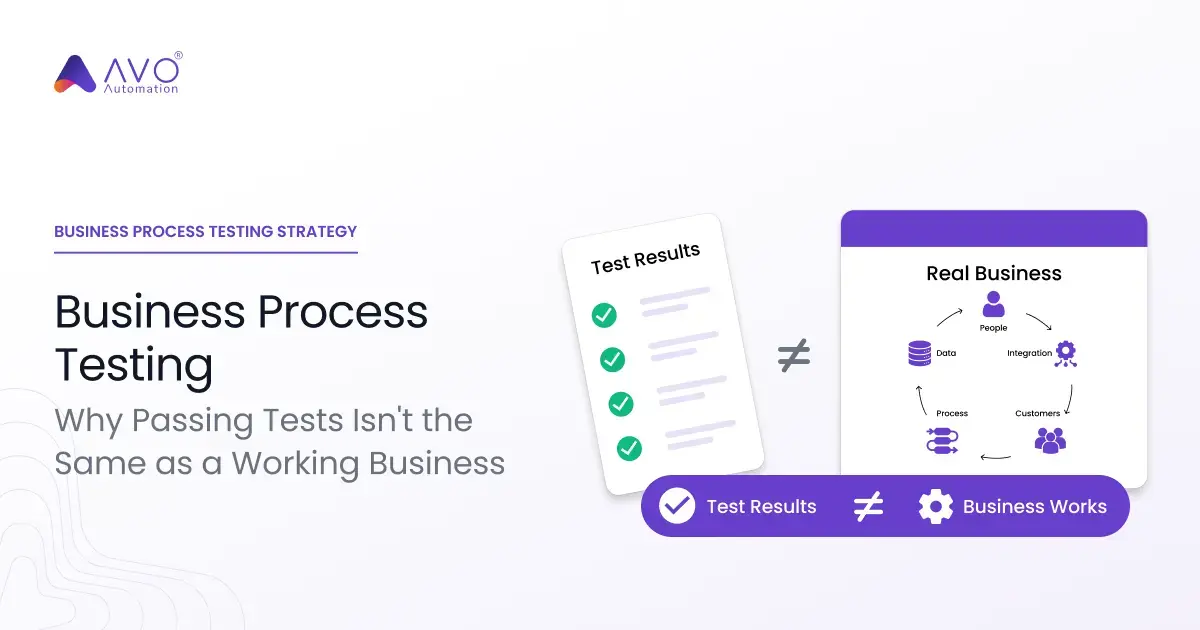
Business process assurance validates whether an entire cross-system workflow still works after a change, not just whether individual scripts passed. Passing tests and a working business process are not the same thing.
Manual BPA does not scale against today's release cadence. Dynamics 365 release upgrades, SAP transport changes, and Oracle Fusion quarterly patches all introduce risk on a schedule that manual regression cannot keep up with.
Prioritize test cases that are high-frequency, business-critical, cross-system, and reasonably stable. Automating everything equally is not a strategy.
No-code business process assurance lets IT directors, ERP project managers, functional consultants, and business analysts build and maintain automation directly, without depending on developers for every change.
Business-Aware, Accountable AI extends BPA beyond execution speed. It understands process dependencies and business risk, and keeps every recommendation explainable and subject to human approval, so testing outcomes tie back to release confidence rather than pass or fail counts.
Every business runs on processes that cross multiple systems: order to cash, procure to pay, hire to retire, record to report. When a system changes, whether it's an ERP release wave, a cloud patch, or a new integration, the question that matters isn't whether the individual test scripts passed. It's whether the business process still works end to end, in production, under real conditions.
Business process exists to answer that question. This guide covers what business process (BPA) is, how it differs from testing individual applications, where manual approaches break down, and what a no-code, AI-assisted approach to business process assurance looks like for Dynamics 365, SAP, and Oracle Fusion environments in 2026
What Is Business Process ?
Business process validates that integrated systems and workflows function correctly together, not just individually. A typical enterprise business process depends on several components working in concert:
- Applications: The ERP, CRM, and enterprise systems that run the process, such as Dynamics 365, SAP, or Oracle Fusion.
- Databases: The systems storing the transactional and master data the process depends on.
- User interfaces: The screens through which business users and functional teams interact with the process.
- Integration points: The connections between systems, such as an ERP passing data to a CRM or a payroll provider.
- Workflows: The sequence of steps, approvals, and handoffs that make up the end-to-end process.
In a software context, business process looks at the same problem from inside the application layer: validating that modules, APIs, user interfaces, and databases interact correctly to support the business outcome the process was built for. The goal in both cases is the same. BPA confirms that a business-critical workflow, such as order to cash or procure to pay, still holds up end to end after a change, by simulating real operating conditions rather than testing each screen or module in isolation.
Why Business Process Is Different in ERP Environments
Generic business process guidance treats every application the same way. In practice, the applications that carry the most business risk today are ERP systems, and each one introduces risk on its own schedule:
- Microsoft Dynamics 365: Twice-yearly upgrades plus continuous updates mean Finance, Supply Chain, and HR processes are exposed to change constantly. Microsoft has confirmed that the Regression Suite Automation Tool (RSAT) reaches end of support on May 15, 2027, after which there will be no further bug fixes or maintenance. Teams still relying on RSAT for D365 regression coverage need a migration plan well before that date.
- SAP ECC and S/4HANA: SAP's mainstream maintenance for ECC 6.0 (Enhancement Packages 6 through 8) ends December 31, 2027; support for earlier enhancement packages (0 through 5) already ended in December 2025. Either deadline pushes organizations through S/4HANA migrations at the same time they need to keep Order-to-Cash and Procure-to-Pay processes running without disruption.
- Oracle Fusion: Quarterly patch cycles mean Finance, HCM, and Supply Chain configurations are retested four times a year at minimum, with FlexField and configuration changes carrying real risk of silently corrupting financial reporting if they go unvalidated.
None of these deadlines are optional or negotiable on the vendor's side. They are the reason business process has moved from a periodic IT activity to a continuous, business-critical discipline.
Manual vs. Automated Business Process
|
Aspect |
Manual BPA |
Automated BPA |
|
Execution speed |
Slow, dependent on human effort |
Fast, executes on demand |
|
Accuracy |
Prone to human error |
Consistent, repeatable execution |
|
Resource requirement |
Requires ongoing human resources |
Requires upfront setup, less ongoing effort |
|
Cost |
Higher ongoing labor cost |
Higher initial investment, lower ongoing cost |
|
Scalability |
Difficult to scale across company codes or business units |
Scales through reusable, parameterized automation |
|
Maintenance |
Manual and time-consuming |
Self-healing automation adapts to UI and workflow changes |
|
Business risk visibility |
Surfaces after the fact, often after go-live |
Continuous, flags risk before release |
Common Business Process Challenges
BPA runs into the same obstacles in most enterprise environments:
- Complexity of business processes. A single process like Order to Cash can span CRM, ERP, logistics, and finance systems. Every integration point is a place where a change in one system can silently break a connected process.
- Resource constraints. Manual regression testing pulls functional consultants, ERP project managers, and business analysts away from higher-value work like exception handling and production readiness, every single release cycle.
- Constant change. Upgrades, transport changes, and quarterly patches mean test cases go stale quickly, and testing environments themselves can drift out of sync with production.
How to Build a Business Process Strategy
A working BPA strategy addresses these challenges directly:
- Automate with intent, not everywhere. Prioritize test cases that are high-frequency, business-critical, cross-system, and relatively stable. A process that runs every sprint and touches revenue is worth automating first. A rarely used screen with a cosmetic UI change is not.
- Validate end to end, not screen by screen. Cover the full path a transaction takes, from creation through every downstream system it touches, so a defect surfaces before it reaches production rather than after.
- Build in regression testing as a standing practice. Every release, transport, or patch should trigger a regression pass against the business-critical processes it could affect, not a one-time test at go-live.
- Design for reuse across company codes and business units. Parameterized automation that runs the same validated process against different datasets scales without multiplying the number of automation assets a team has to maintain.
- Measure business risk, not just pass and fail counts. A dashboard showing 95% of tests passed doesn't tell you whether the 5% that failed sits inside a revenue-critical workflow. Tie testing outcomes back to which business processes are actually at risk.
What to Look for in Business Process Software
Choosing the right platform comes down to a few criteria that matter in ERP environments specifically:
- No-code test creation. IT directors, ERP project managers, functional consultants, and business analysts should be able to build and maintain automation directly, without writing code or waiting on a developer for every change.
- Business-Aware, Accountable AI. AI that understands business process dependencies and prioritizes validation based on business risk, not just screen coverage, with every recommendation explainable and subject to human approval.
- End-to-end test coverage. The ability to validate a process from start to finish across every system it touches, not just the primary application.
- Cross-platform compatibility. Testing across web, desktop, ERP, and mainframe environments, spanning a wide range of technologies from a single platform.
- Parallel and distributed execution. Running tests concurrently to cut regression cycle time, especially valuable when the same process needs to be validated across multiple company codes or business units.
- CI/CD integration. Fitting into existing DevOps pipelines so testing runs continuously as changes are deployed, rather than as a separate manual gate.
How Avo Assure Approaches Business Process Assurance
Avo Assure goes beyond test automation to Enterprise Business Process Assurance. With no-code test creation, Business-Aware, Accountable AI, and end-to-end test coverage, Avo Assure helps teams validate business processes across Dynamics 365, SAP, Oracle, and every connected system, without relying on developers.
In practice, that looks like Synergy Marine Group, one of the world's largest ship management companies, validating standardized SAP business processes across multiple company codes and connected applications, including Microsoft Dynamics 365 Business Central and SAP Concur. Working with Accenture, the team reduced manual regression effort by 90% and reached approximately 80% automation coverage of planned business scenarios, using reusable automation instead of building separate scripts for every company code.
Read the full Synergy Marine Group and Accenture case study for the complete breakdown of the engagement and its results.
Across enterprise deployments generally, Avo Assure customers report:
- 10x faster time to market with intelligent, end-to-end test automation
- 90%+ business process automation coverage
- 85% less maintenance effort, through self-healing automation
- 80% reduction in effort required to create and execute tests
The right business process approach determines whether a release goes smoothly or becomes a production incident.
See how Avo Assure helps you move beyond test automation to business process assurance and book a demo to get started.
Frequently Asked Questions
What is business process assurance?
Business process assurance (BPA) validates...
Business process assurance (BPA) validates that an integrated business workflow, such as order to cash or procure to pay, works correctly end to end across every system it touches, rather than testing each application or screen in isolation.
How is business process assurance different from regular software testing?
Regular software testing typically validates...
Regular software testing typically validates a single application or module. Business process assurance validates the full workflow a business depends on, which often spans multiple systems, such as an ERP, a CRM, and a payroll provider, and confirms the process still functions correctly as a whole after a change.
Why does business process assurance matter more in ERP environments?
ERP systems like Dynamics 365, SAP...
ERP systems like Dynamics 365, SAP, and Oracle Fusion change on a fixed vendor schedule, whether through upgrades, transport changes, or quarterly patches. Each change carries a real chance of breaking a business-critical process like financial close or order fulfillment, which makes continuous validation a business necessity rather than a periodic IT task.
Can business process assurance be automated without a dedicated QA team?
Yes. No-code platforms let functional...
Yes. No-code platforms let functional consultants, business analysts, and ERP project managers build and maintain business process automation directly, without relying on developers or ongoing support from implementation partners.
What is the difference between test automation and business process assurance?
Test automation confirms that a...
Test automation confirms that a script ran and passed. Business process assurance goes further: it confirms that the underlying business process, such as Order to Cash, still works correctly end to end after a change, and ties that outcome to business risk rather than a pass or fail count alone.
How often should business-critical processes be regression tested?
Business-critical processes should be...
Business-critical processes should be regression tested every release cycle, and again after any configuration, transport, or patch change, since ERP environments on continuous release schedules introduce risk multiple times a year, not just at major upgrades.
Does business process assurance cover processes that span multiple ERP or enterprise systems?
Yes. Processes like Order to Cash or...
Yes. Processes like Order to Cash or Hire to Retire rarely stay inside a single system. Business process assurance should validate the full cross-system path, including CRM, logistics, finance, and HCM platforms connected to the core ERP.
What should I look for in business process assurance software?
Look for no-code test creation, Business...
Look for no-code test creation, Business-Aware AI that prioritizes validation by business risk rather than screen count, end-to-end coverage across every system in the process, and the ability to reuse automation across company codes or business units without rebuilding it each time.